


AI in the field: co-pilot, not autopilot


The loudest narrative in field operations AI right now is autonomy: agents that capture evidence, validate it against planned work, and approve jobs without a human in the loop. Fulcrum sees the same potential in autonomous agents, and takes a harder look at where that architecture serves the field and where it doesn’t. In high-variability, high-consequence work, the more valuable investment is AI that augments worker judgment rather than routes around it.
Every major field service platform has an AI story right now, from generative AI and Large Language Models to agentic AI workflows. The industry’s dominant narrative is trending fast toward autonomy. That means autonomous validation, autonomous approval, and AI agents that review field-captured evidence and decide whether work is complete. For certain use cases, that architecture makes sense.
For others, it hands a critical judgment call to an AI system that was never standing in front of the asset. The question worth asking before the industry settles on a consensus is how much authority AI should have once it gets to the field.
The optimism around AI in the field is justified, especially as the broader AI field moves from back-office assistance into physical operations. A system that never tires, never skips a checklist item at hour nine of a shift, and can surface patterns across thousands of inspections that no individual technician would ever see is a genuine asset. Dismissing those advantages because the technology is still maturing misses the point.
Imperfect matters more, though, when the output is a regulatory record or a safety sign-off. A model that hallucinates a field condition creates a different category of problem than a chatbot that fumbles a product recommendation. Physical assets have physical failure modes. A missed crack in a foundation, an incorrect torque value, a flag that should have triggered a reinspection: those errors carry downstream consequences that no software patch addresses after the fact.

The gap between a confident AI output and an accurate one becomes a liability when a physical asset and a compliance record are both on the line.
Field operations have always required workers to exercise judgment in conditions that are noisy, variable, and frequently outside the SOP’s scope. Worker judgment is the mechanism by which a documented process meets an actual asset in the real world. It is load-bearing for both safety and accuracy. AI in the field earns its place by sharpening that judgment and extending what the worker can capture and act on, not by turning complex tasks over to field agents without human review.
Fulcrum’s approach to AI in the field starts with a design question most vendors skip: what the worker is doing with their hands.
On an infrastructure inspection, for example, they are on the asset. Their hands are occupied, eyes on the equipment, attention fixed on what they are finding. A UI that requires stopping, unlocking a device, and tapping through a form to log an observation is an interruption dressed up as a workflow. Smart glasses, a camera, and a microphone are the right form factor for last-mile field work because they keep the worker’s attention where the work is.
Fulcrum’s vision for AI in the field comes down to two personas and a clear division of labor, with an AI solution designed around worker judgment rather than autonomous field agents. The Sidekick handles capture: photos, voice observations, asset condition data, and field context, pulling in what the worker is generating without asking them to stop generating it. The Guide handles guidance, walking the worker through the procedure, flagging anomalies, and surfacing what the SOP requires at each step.

When the Guide flags a missed step or the Sidekick captures something unexpected, the worker decides what happens next. The AI captures and prompts. The human owns the verdict. “Still under human control” is a design commitment, and it holds from first observation to final sign-off.
Autonomous approval earns its place when the variables are bounded and a miss can be fixed. A fiber drop with standardized evidence requirements and a narrow pass/fail condition is a plausible candidate for autonomous approval. The variables are bounded and the failure mode is recoverable.
The governance question appears when the same pattern is applied to high-variability field work. AI agent governance needs to define when the system can guide, flag, or recommend. It also needs to define when a human must make the final call.
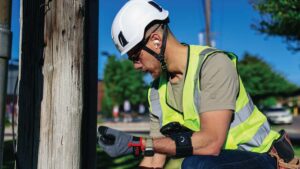
A pole inspection shows where the partnership model earns its keep. An AI reviewing a photo can flag potential lean or surface patterns from previous inspection cycles. Feeling the rot in the wood, or noticing how the vegetation load has shifted since the last visit, requires a worker on the asset. The value of AI in that context is giving the worker better information to act on, with the worker verifying what the AI surfaces.
A system approving the inspection without those inputs is operating on an incomplete picture because the architecture chose to exclude them.

Autonomous approval trades human judgment for throughput. For low-stakes, high-volume, well-defined work, that trade often makes sense. For inspections where asset condition is variable and the consequences of a miss are serious, the math is harder than the demos make it look.
Field conditions have a way of producing combinations and edge cases the training data did not cover. That gap is manageable when the failure mode is recoverable. In high-variability, high-consequence work, it is the strongest argument for keeping a worker in the decision seat.
Fulcrum’s AI features are productivity and data quality tools, built to extend what field workers can do on a job and sharpen the quality of what they capture without positioning an AI employee or autonomous field agent as the final decision-maker. Audio FastFill converts spoken field observations into structured form data, hands-free, in real time. Photo FastFill, currently in development, brings visual capture into the same workflow. And Insights gives operations teams a natural-language interface for querying what their field data shows.
The roadmap builds from there to provide more context-awareness and smarter anomaly detection. It delivers guided inspection flows that adapt to what the worker is finding. A richer knowledge graph helps the AI surface relevant contex, with the same design principle running through all of it. The system is designed to get more useful as the worker’s experience deepens. It adds capability without adding friction or taking over the call. The worker stays in the driver’s seat.

Guide is a deliberate choice about where accountability lives in a workflow involving physical assets, regulatory obligations, and workers who carry years of hard-won field experience into every job. AI in the field is most valuable when it makes those workers faster and more accurate. It earns trust by augmenting the person holding the equipment, and the roadmap is built around doing exactly that.
Wherever the work requires hands on an asset and eyes on the job, the interface needs to get out of the way.
Watch the Fulcrum vision video to see how AI in the field can support capture, guidance, and context-aware decision-making without turning field agents into autonomous approvers Then request a free custom demo to talk through how it applies to your operations.