



Environmental remediation and restoration projects need defensible field records
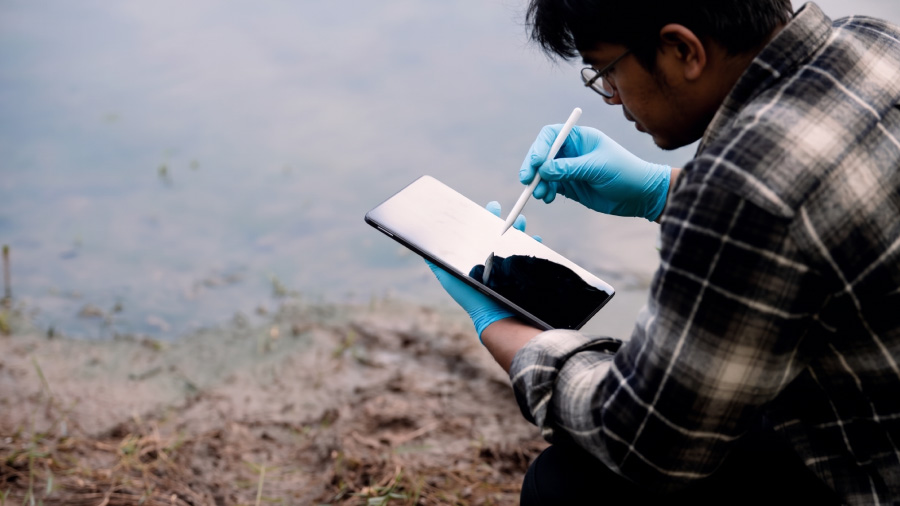

Years after an environmental remediation project wraps, someone will open its closeout file and start asking questions the field team is no longer around to answer. Some of those answers exist only if they were captured on site, on the day of the work. Find out which records a reviewer will ask for, and how teams use Fulcrum to build a file that holds up long after closeout.
Key insights
Groundwater cleanup by pump and treat can last from a few years to several decades. Over a span like that, the people who start a site’s record may be gone by the time anyone asks what it proves.
Whatever the team observed on site survives only if it went into the record at the time. Memory leaves with the people who hold it, and a report assembled afterward works with whatever the field produced.
Defensible closeout on an environmental remediation project begins in the field, on the first day of mobilization. The rest of this post works backward from the closeout file’s readers to the field records that answer them.
A closeout file has a longer shelf life than the field team that produced it. Wetland mitigation sites, for instance, carry a monitoring period of at least five years under federal mitigation rules, and longer where the wetland develops slowly. State cleanup programs generally review the work before issuing a no further action decision. When a brownfield later changes hands, a buyer seeking federal liability protection needs an inquiry that reviews government records on the property and identifies any data gaps.
Long after closeout, the responsible party’s Environmental Compliance Manager or EHS Director still answers for the work. Where contamination stays in place, that responsibility takes legal form, with institutional controls such as land use restrictions attached to the property. When a new firm takes over, the next consultant inherits whatever record the last firm left behind.
Time works against everyone who opens the file later, since the people who did the work may be long gone. The file has to speak for itself, with where, when, and by whom written into every entry.
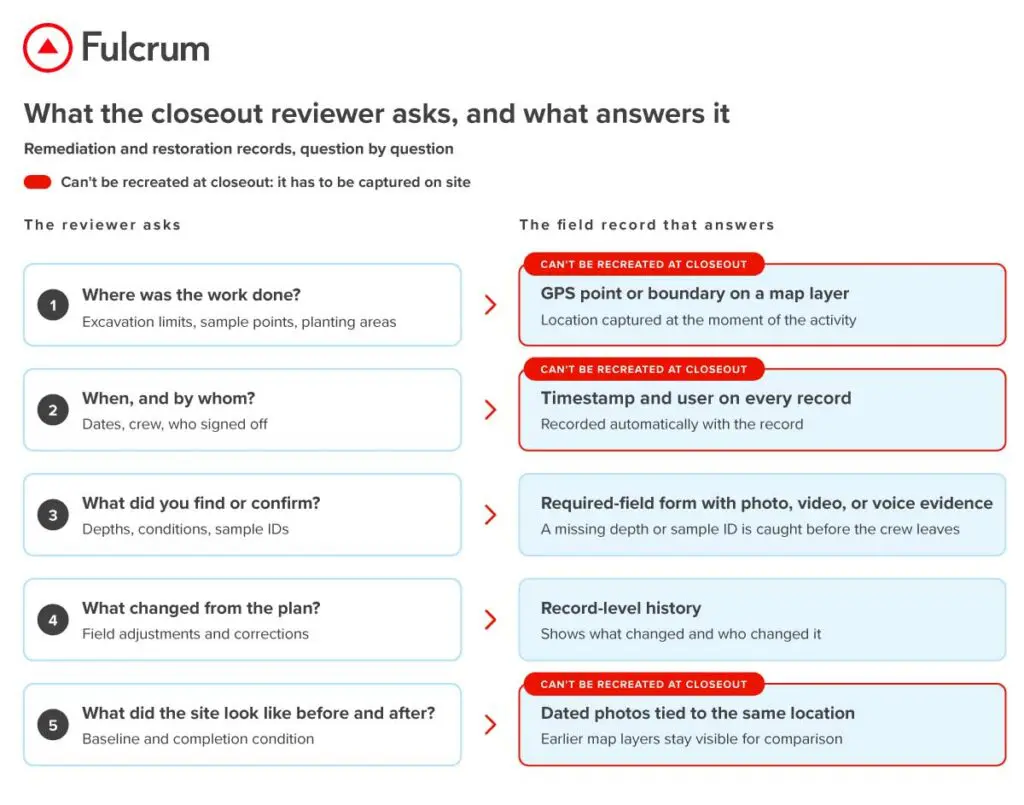
Regulations vary by program, and the questions below are the ones a closeout file has to be ready to answer.
On a soil remediation job, those answers cover excavation cells, depths, field screening readings, waste tracking for every load hauled off site, and confirmation samples from sidewalls and floors. On a wetland restoration site, they cover the grading and planting laid out in the mitigation plan, then the plant community’s progress and water levels through each monitoring year.
Location data stands up as evidence in other regulated fieldwork, too: Fulcrum client Great Lakes Wellhead used it to prove environmental compliance at wellheads. A complete, independent record holds up just as well. For example, when a utility client’s system came up about 80 service records short, Diverse Pipeline Services pulled its own field records by address and spared the client a costly winter re-excavation.
Every one of those questions traces back to something the team recorded in the field. Only the team on site can capture answers tied to a specific place and moment. No document written later can produce them.
The familiar closeout package comes together in the office from notebooks, photo folders, spreadsheet trackers, and a long email thread. Each source holds a piece of the answer, and the systems behind them don’t talk to each other. Assembly falls to whoever writes the report, sometimes months or years after the fieldwork wraps.

Photos tend to lose their context first, since a shared folder holds the image without saying which feature it shows. EPA’s own Region 4 field investigators must log each image’s location, subject, date, time, and photographer under the region’s evidence procedures. Without that log, a photo pulled three years later may not show which sidewall or excavation cell it belongs to. Other details slip as they move from field notes into office tools and reporting processes. A retyped depth or sample ID can pick up an error the lab report later exposes, and a change to the plan can end up stranded in an email thread.
A diligent project manager can patch some of those gaps at closeout, but the rest are gone for good. Location, time, and the site’s before-and-after condition exist only in the moment, and no amount of office work brings them back. Defensible remediation documentation depends on capturing those three in a structured record before the field team leaves the site.
Good remediation project management treats closeout as a field deliverable from the first day of mobilization. Sampling programs already work this way, since EPA’s Superfund sampler’s guide holds samplers responsible for custody from the moment a sample is collected. Fulcrum’s webinar on remediation workflows shows field teams carrying the same discipline into sampling programs and site assessments.
The rest of the field record deserves the same treatment. A closeout file built that way, entry by entry while the work happens, has its answers ready when the questions arrive.
Fulcrum’s Field Operations Management platform captures the field record that a closeout report is built on. Firms build a structured form and workflow for each field activity, from excavation and sampling to planting and restoration monitoring visits. Required fields catch a missing depth or sample ID while the team is still on site to fix it, so data quality holds up from the start.
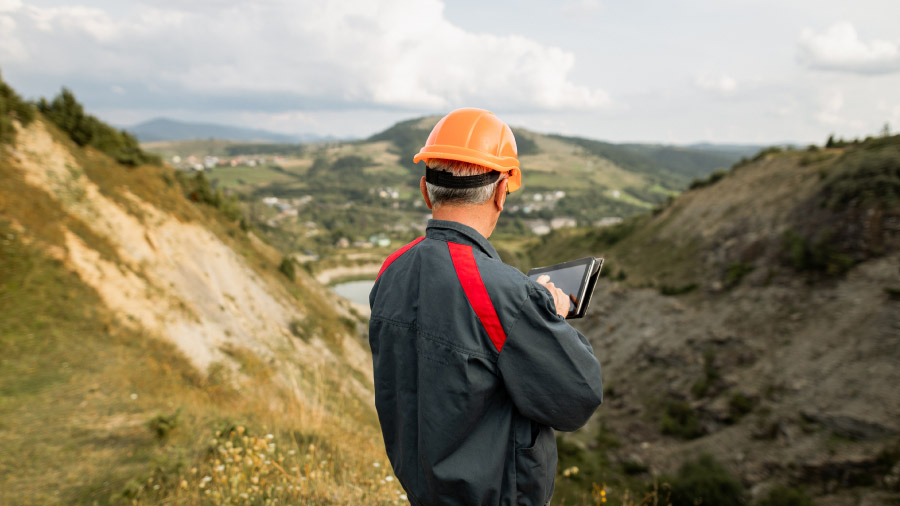
Every record carries GPS coordinates, a timestamp, and its author, with photo, video, or voice evidence attached. Capture works offline, so a mitigation site far past the last cell tower produces the same complete record. Record-level history logs every later edit with who made it and when, so the original entry never disappears.
ArcGIS integration and map layers tie each record to a place and keep earlier states of the site visible. Every record built this way reaches the closeout file in the shape a reviewer expects, ready for compliance reporting.
To see how records captured in Fulcrum answer a reviewer, it helps to follow a single piece of work from start to finish. The example below is a hypothetical brownfield remediation project on a site slated for redevelopment, following one excavation cell from the day it’s dug to a lender’s inquiry three years later.
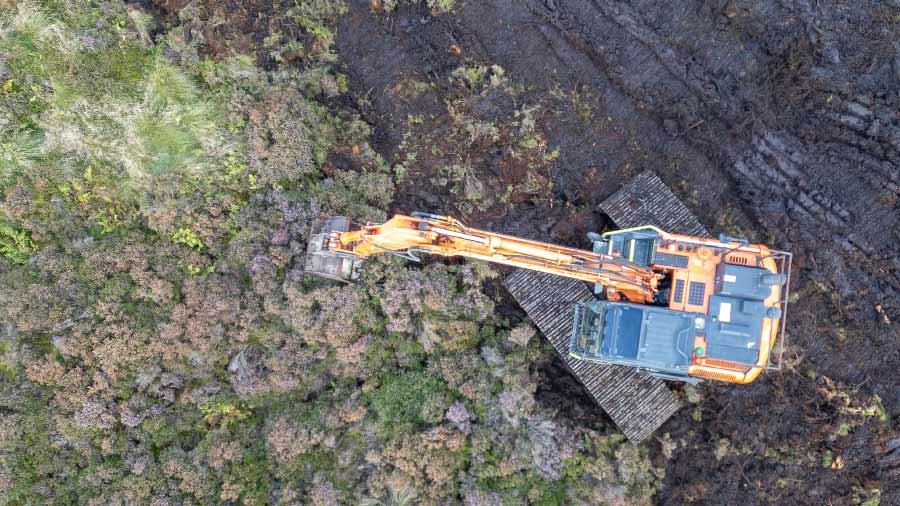
The field team starts digging the cell along the northeast property line and maps its limits in Fulcrum. Each entry captures depth, field screening readings, and confirmation sample IDs from the sidewalls and floor. Photos taken through the form arrive with location and time already attached, so nobody has to sort them later.
Screening turns up impacted soil below the planned depth, so the team takes the cell deeper and records why. When the project manager redraws the boundary that afternoon, record history keeps both lines and who changed them. After backfill, the team photographs the restored surface from the same points it used on day one.
Three years later, a lender’s reviewer asks what came out of that corner and which samples confirmed the cleanup. A project manager who never set foot on the site finds the cell on the map, earlier boundary included. In Fulcrum Insights, a plain-language question pulls up what the team excavated there and which confirmation samples it collected. The sample IDs match the results in the firm’s lab database, and the before-and-after photos share coordinates. The reply to the lender comes together quickly, because every piece came from the field on the day of the work.
Nothing in that reply had to be reconstructed from memory or a photo folder. The questions a reviewer asked three years on were answered by records the field team made on the day the cell was dug.
Every environmental remediation and restoration project ends up in front of someone who wasn’t there. The reviewer may arrive a year later or decades later, and the file has to stand in for the field team when that happens. Questions about where the work happened and what the site looked like before it started have only one source: the record made on site, at the time.
For a project manager, closeout work starts the day the field team mobilizes. The report still gets written at the end, and it comes together faster when the evidence behind it arrives complete from the field. Teams that treat the field record as part of the closeout deliverable hand every future reviewer a file that explains itself.
Somewhere down the line, a reviewer will open the file your team is building today. Fulcrum gives environmental teams a way to build that file while the work happens, from field workflows to closeout reporting, and the data sheet lays out how. To see what that looks like in your own projects, request a free custom demo.
What does a reviewer look for in an environmental remediation closeout file?
An environmental remediation closeout file should show where the work happened, who recorded it, and when. It should also document what the team found, what changed from the plan, and the site’s condition before and after the work. The strongest answers trace back to records made while the work was happening.
Who reviews an environmental remediation closeout?
State cleanup programs generally review the work before issuing a no further action decision. Lenders, buyers seeking federal liability protection, the responsible party’s compliance staff, and consultants who inherit the site may all read the same file later.
How long does an environmental remediation record need to hold up?
EPA notes that groundwater cleanup by pump and treat can last from a few years to several decades. Wetland mitigation sites required under federal permits carry monitoring periods of at least five years, so remediation and restoration records may need to answer questions long after fieldwork ends. More broadly, a remediation that leaves contamination in place can keep its record under scrutiny for as long as that contamination remains.
Why can’t a closeout report be assembled from notes and photos after the work ends?
The exact location of environmental remediation work, its timing, and the site’s condition beforehand can only be recorded firsthand while the work is happening. Once soil is excavated and backfilled, details that were never recorded are hard or impossible to recover. Photos stored in shared folders can also lose track of which feature they show.
What is chain of custody in environmental remediation, and how does it relate to field records?
Chain of custody documents who held a sample from the moment it was collected through shipping and analysis. EPA’s Superfund sampling guidance holds samplers responsible for custody from collection until the samples ship to the lab. Applying the same discipline to photos, measurements, and changes made in the field makes the rest of the record easier to defend.
Can an environmental remediation site be reopened after it receives a no further action letter?
A no further action letter is a state government’s written statement that it has no present intention to require additional cleanup at a remediated site. Some of these letters include reopener provisions that reserve the government’s right to require more cleanup under certain conditions, such as new information about the site. When a remediated site is reopened, the original field record becomes key evidence of what the cleanup removed and confirmed.
What should a soil remediation field record capture?
Field records for an excavation-based soil cleanup can include excavation cells, depths, field screening readings, and confirmation samples from excavation sidewalls and floors. Each entry should carry a location, a timestamp, and the name of the person who recorded it.
How are wetland restoration sites documented for closeout?
When a wetland restoration project serves as compensatory mitigation under a federal permit, its mitigation plan lays out site grading and the methods for establishing the plant community. Field records then track how the plant community progresses through each monitoring year.
What does Fulcrum do for environmental remediation teams?
Fulcrum is a Field Operations Management platform that captures the field record a closeout report is built on. Teams build structured forms and workflows with required fields, and every record carries GPS coordinates, a timestamp, and its author, with photo, video, or voice evidence attached where needed. Record history logs each later edit with who made it and when.
How can an environmental remediation project manager answer closeout questions about a site they never visited?
An environmental remediation project manager who never visited a site is best served by field records that carry the location, time, and author of each entry. With those details attached, the manager can find each excavation or sample point on a map and see who recorded it and when. Records built that way stay usable long after the original field team has moved on to other projects.